Feeds:
Posts
Comments
Cactus finger

Despite surgery and picking, the cactus resists

Many years ago, more than I dare to remember, I bought a packet of cactus seeds after seeing mini cacti growing in “fancy” pots!

The plant centre no longer exists and I promise it had nothing to do with the cursing that followed that purchase.


Carefully adhering to the planting instructions on the packet, I placed the pregnant pot out of  sight and promptly forgot about it. Months later I remembered my cacti seeds.  My…how they had grown. The next stage was transplanting them into single larger pots, so that I could tuck them away again.

Later, to my surprise, two plants had shot up in protest at their abandon, and the rest unfortunately didn’t survive to see the light of day.

Now, 20 years later, I am unconditionally and secretly picking at the mini cacti growing out of my right forefinger. My left forefinger was successfully operated on years ago for the same problem. Somehow my right forefinger survived all medical attempts to oust it.

Cactus spines are produced by specialised structures and act as protection against herbivores in  deserts….(plant pots included). The word cactus is derived from the Ancient Greek (kaktus).

The first acknowledgement of this spiny “pain” was when my son said “Mum, what’s that growing on your finger?” My son, whose own son is now in his early twenties, cannot believe that I still possess this painful eyesore. The NHS have given up too – the last visit was met with a rebuff. So, I too give up.

My advice to you all is: DON’T GET PRICKED BY A CACTUS.

A Grand Day Out

church_daffodils2Last Friday I caught the 7.15am train from Brough and met my youngest daughter Kim at King’s Cross at 10 am. It was a very hot, sunny day. From there we went to Borehamwood in the northern suburbs and visited the cemetery where my first daughter Deborah lies. Her short life of just 6 months would have been much longer were she born today.

We tidied her grave, wiped down the stones so that the lettering was visible. At the time of her death, my husband won £60 on the football pools and that was the cost of the grave stone. I’m pleased we bought it. Bulbs still come through in the spring.

We returned to Islington and had a super lunch at Carluccio’s (who by the way is opening in Beverley shortly). Sat by the canal, enjoyed the pigeons in a small park, visited a Japanese friend of Kim’s in her studio and made our way back to King’s Cross where I felt uneasy with the number of people milling around with no police in sight – I am sure they were there. Caught the Hull train at 7ish and arrived home at 9.30pm.

A very full and satisfying day.

Dent de lion

fields of dandelionsIs the dandelion the “flower” of the spring season?

It seems so! They have proliferated in so many gardens this year, particularly front gardens and verges, whether people like them or not. With so many dandelions in bloom, they have woven a carpet of yellow, which can be easily confused with oilseed rape about to appear in farmers’ fields and hedgerows.

Dandelions (from the French “dent de lion”, depicting their sharp lion tooth-like leaves) are classed as a weed – a plant that grows where it is unwanted! Dandelions are thought to have evolved about thirty million years ago in Eurasia and have been used as food and medicine for much of recorded history. The dandelion has diuretic properties and provides a source of nectar for most insects.

I remember collecting dandelion flowers from fields and roadside verges years ago for a relative who made a very invigorating white wine from them and just a hint of Pinot Grigio!

Would you believe that the Germans have tested tires made with a blend from dandelion-rubber and are scheduled to test them on roads during the coming years.

A tortoise I “rescued” from a pet shop years ago named Napoleon, survived by his ‘girlfriend’ Josephine, both believed to be over 50 years, loved to munch on dandelions, leaves and flowers. I believe dandelions extended their lives. Who knows, maybe dandelions could extend our lives too. Having said that, tortoises on the Galapagos live to 100 and there is only the roughest vegetation available to them.

Postman dogLetterboxes are sometimes the bane of the postman/woman.

Why? Well, those forms of correspondence that require extra shove, provide silent, but aggressive canines a great opportunity to snap with the force of a crocodile. It’s a bigger problem than you might think. Apologetic owners usually reveal themselves smugly with dog-in-hand the following day. They caution the postman to be more careful next time. Silence is not always “golden”.

Last week I witnessed such an event. Blood is cheap! Fore (four?) fingers withdrawn in haste, ultimately leading to a rush to A & E and a long wait for treatment, leaving a painful, throbbing protrusion. All caused by a seemingly cute little tail wagging dog… Fashionable dogs can be so aggressive.

On average around nine postmen and women a day are attacked by dogs across the UK with over 3,300 attacks taking place from April 2013 to April 2014, an 8 per cent increase on the previous year. Some of the injuries are horrific. New legislation means owners can now be prosecuted for dog attacks that take place on private property. Dog owners that alarm postmen face criminal prosecution since October 20, 2014 with fines of up to £20,000 or the prospect of theirs pets being seized. So dog owners beware, the postman is biting back! The Royal Mail last year launched a Dog Awareness Week to raise visibility of the problem.

The private letterbox dates back to 1849, when the Royal Mail first encouraged people to install their own letterboxes to facilitate the delivery of mail. Before then, letterboxes of a similar design had been installed in the doors and walls of post offices for people to drop off outgoing mail. An example of such a wall box (originally installed in the wall of the Wakefield Post Office) is dated 1809 and believed to be the oldest example in Britain.  It is now on display at the new Wakefield Museum.

Postmen will be glad to learn that they have nothing more to fear from my letterbox than a slight need for maintenance.

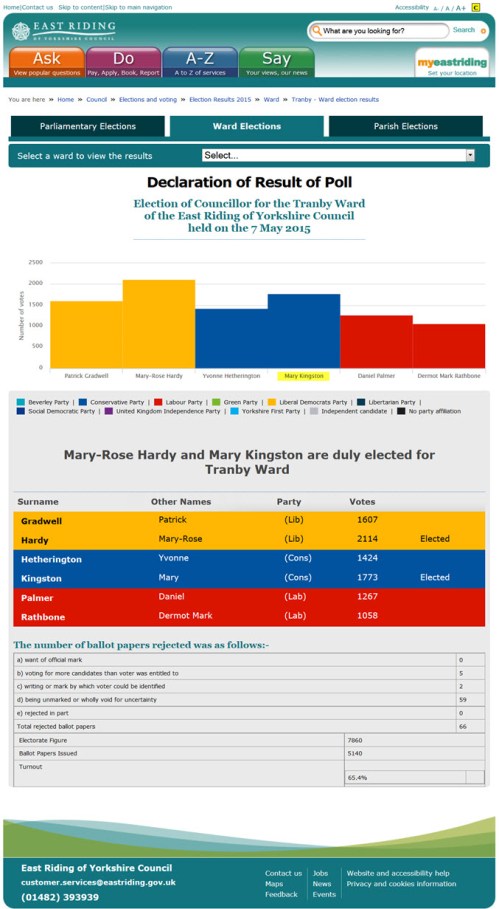
I would like to express my sincere thanks to Douglas and the team that so diligently supported me in the field and especially to those that voted for me. A very special mention to David Davies for his support and to David Cameron. Their hard fought campaigns and spectacular victories made it all possible.

Now it’s down to work.


Victory 2015

Photo credit - sandiquiz

Photo credit – sandiquiz

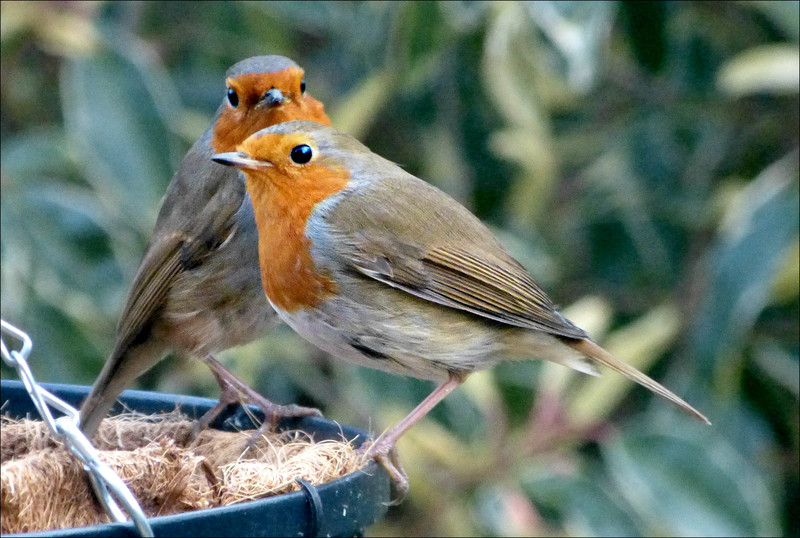
Gathering in the washing from the line this afternoon, I was greeted by that cheery chirp of the garden or European robin.

Actually calling him “robin redbreast” is deceptive, because it has a distinctive orange breast. This is because the colour orange was unknown in the English language until the 16th century.

The European robin is one of many species originally described by Linnaeus in his 18th century work. It prefers spruce woods in Northern Europe, contrasting with its preferences for parks and definitely gardens in our British Isles.

The robin is considered generally to be the gardener’s “friend” and for reasons of folklore – should never be harmed! They are generally unafraid of people and much drawn to human activities involving the digging of soil, in order to look for grubs and worms. My cheery garden friend is no exception and follows me around to see if I am going to unearth a wriggly accompaniment to the daily allocation of sunflower hearts I distribute. The robin can also be a night “flitter” and has been observed actively hunting insects on moonlit nights.

Would you believe European robins can be found in Fuerteventura. Very surprising, as the species does not breed either on that island or on neighbouring Lanzarote. They are actually wintering on the islands or just passing through during migrations between Africa and Europe.

Which makes me wonder… has “my” garden robin just arrived from Lanzarote?

I will never know. But it surely does.

Are ants political?

imageAnts are fascinating creatures. I watched one scupper across my table, avoiding the sugar I had mischievously placed in its way. It had a higher purpose. An objective beyond the game I wanted to play with it.

Ants start life as an egg. If fertilised, the progeny will be female. If not, then male – in itself quite amazing. I wonder what that says about male ants ! Their lives are the shortest – just 3 years, whereas queens can live for up to 30 years.

Ants can form colonies of varying sizes – from just a few living in a crack in the wall, to highly organised colonies of millions that infiltrate large territories.

They are socially ‘engineered’ with mathematical precision – workers, soldiers and other specialists. New workers spend the first few days of their adult life caring for the queen. Young and ‘graduate’ ants dig and do house work.

Ant society has divisions of labour, communication channels and an ability to solve complex problems. Each member of the community knows its place, its role, its purpose. There are no cases of unrest, disorder, strikes or mutiny. Their instinctive ability to modify habitat and tap resources and defend themselves is something we humans observe in awe.

image

The last TV debate – reinforcing divisions rather than advancing the debate

They exist for their mutual success. They are selfless. Humans on the other hand are self-aware so motivated by individual success. And this I suppose, is why our society will never function in the same way. Maybe that’s a good thing, but at times, when I watch the news and political debates like the last one, I do wonder.

Ants execute a social formula. A social formula that can only be embedded in their DNA. Otherwise how do they acquire it ? They have no forum for debate, no democratic elections, no opposition. They enter life and just get on with it – and do extremely well.

Ants seem to be born with politics – the same politic – in their ‘souls’ for the service of the community at large. Now that’s something all politicians can learn from.

Rats are revered for their intelligence

Rats – revered for their intelligence

The English dictionary describes “the rat” as a rodent resembling a large mouse – both considered serious pests capable of passing on disease. The average lifespan of a wild rat is about a year due to predation. The common species are opportunistic – mostly living near humans. They cause substantial food loss in developing countries.

After just watching a TV programme about pest control, I was amazed at how quickly they can multiply. Junk piling up in sheds and gardens provides a natural habitat for “nasty” rats. That made me observe my immediate neighbourhood more closely, which on the surface seems neat and tidy but on closer inspection with my new-found knowledge is a potential haven for rats.

Pied Piper of Hamelin - said to be based on a true story. Stained glass Hamelin church window.

Stained glass Hamelin church window depicting the Pied Piper of Hamelin – said to be based on a true story.

This put me in mind of the 16th century “Pied Piper of Hamelin”  folklore about that German city’s rat problem. The rat catcher’s magic pipe lured away the vermin, but when the citizenry refused to pay him, he retaliated angrily by turning his pipe’s magic powers on the children. Some say he returned the children after being paid, others that he took them to a beautiful land. The earliest known record of the story is within the church of Hamelin itself – depicted in its stained glass window.

That made me wonder – are rats musically inclined? Experiments have shown that music stimulates their ability to reason. Maybe there is something to the story – they are, after all, revered for their intelligence and have demonstrated compassion – arguably more than humans.

Laboratory rats have also proven valuable in psychological learning studies and other mental processes. Their ability to learn means they get used in problem solving tasks and simple avoidance conditioning. A good example of how useful rats can be is in Africa, where they are trained to detect landmines and can even detect tuberculosis by sense of smell.

darwin

Charles Darwin, 1809 – 1882. Author of “The Origin of Species”

As Darwin illustrated so profoundly – any being is the product of its environment. In junk, rats are pests. In the right hands, they save human lives.

bluebells_2234194b Matt Binstead

Photo: Matt Binstead

Spring is almost here. A wonderful season of new-born animals and birds – when nature’s spark sets off another renaissance in gardens, hedgerows and woodlands throughout the countryside.

There is nothing more remarkable than the bluebell – usually first to cast its leaves long and wide to the surface. The flowers are deep violet or blue and what a joy it will be to see so much blue again in the garden. This spring will be a bumper year as the bulbs have propagated with time; just like their snowdrop bed mates, purchased from reputable garden centres.

Did you know that Britain contains more than half of the world’s population? Some common names for the bluebell are “harebell“, “auld man’s bell” and “wild hyacinth”.

BluebellsI remember as a young girl, we would go as a family to gather bluebells and primroses in the woods in Bedfordshire. The flowers did not survive long. But it was a joy to see their floral display in vases.

The main threat to their survival is people picking them and illegally digging up the bulbs. That is why it is now forbidden by UK law to gather wild bulbs from woodlands and hedgerows – punishable by a fine of £5,000 per bulb and up to 6 months imprisonment! Quite right too. You live and learn!

Little Aimee

In 2010, little Aimee fell in dog’s mess and wiped her eye. Quick intervention from doctor’s saved her life, but she is now partially blind.

Dog’s mess. A subject I’ve written about before. Dog excrement is a real public health hazard. It contains bacteria that can cause stomach upsets. Young children are particularly at risk due to their weaker immune systems as poor little Aimee here will attest to.

Unfortunately, the problem isn’t going to solve itself. Irresponsible dog owners that lead their pets down snickets have found it all too easy to soil the public highways. Too many snickets in Anlaby and Anlaby Common suffer from this problem – particularly on paths leading to Acre Head School. And the local residents are complaining.


dogtoiletpostcard_2_2-page-001So it’s time selfish dog owners picked up their dues – on-the-spot fines of up to £80 with a maximum of £1,000 for serious offenders. How?

The East Riding is fighting back. Dog owners – be warned. Someone may be watching you.

The East Riding has appointed wardens to patrol the problem. And the East Riding’s and Government’s dog control websites let people report uncivil dog owners and their dogs.

So the next time, dog owner’s need to keep one eye looking over their shoulder and think about that on-the-spot fine that may be headed their way.

Report dog fouling here.